-
The Surface Illusion: A $30 Switch That Costs $3,000 to Replace
-
The Causation Is Backward: Quality Vendors Don't Charge More Because They're Better — They Can Charge More Because They Deliver
-
The Experience Override: Microinverters Aren't Automatically "Better" — They're Different
-
Where the Spec Actually Lives: Charge Controllers and the Bill Nobody Calculates
-
"But We Have Budget Constraints"
-
My Position, Restated
Here's an opinion I've earned the hard way: most of the solar system failures I've audited didn't start with the inverter. They started with a $40 battery disconnect switch nobody spec'd properly, a dual output solar charge controller selected for price instead of duty cycle, or a spec sheet that only got read up to page one.
The solar industry has a brand-name problem. We buy reliability like it's a logo, when in reality it's a checklist. That's not a knock on any manufacturer — it's a knock on how procurement decisions get made when the deadline is tight and the quote sheet has a number at the bottom.
I've been the person who signs off on batches before they leave the warehouse. I've rejected roughly 12–15% of first deliveries in 2024 for spec deviations that would have been invisible on a photo. So when I say reliability lives in the details, I mean it literally — because I've watched what happens when it doesn't.
The Surface Illusion: A $30 Switch That Costs $3,000 to Replace
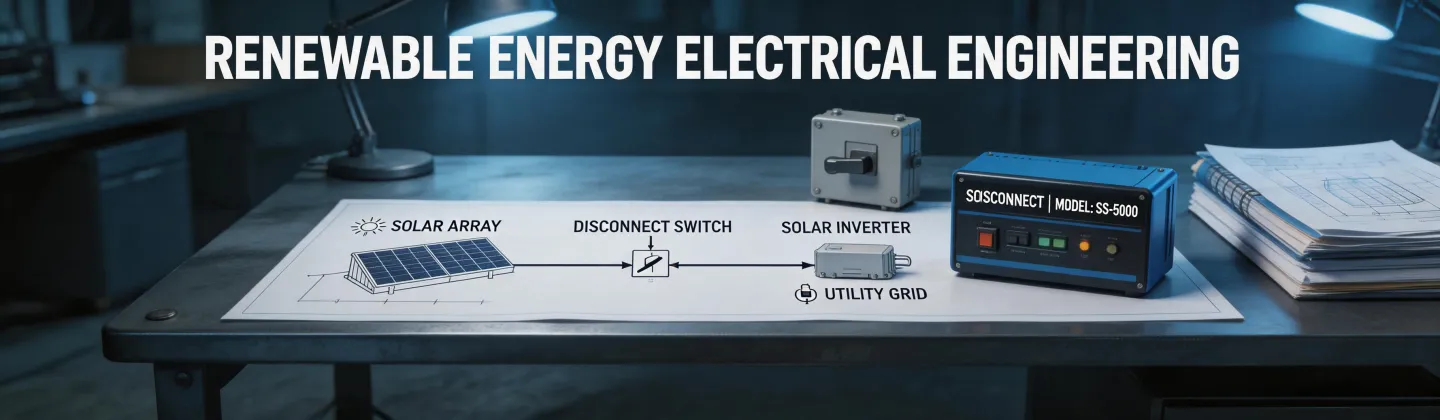
From the outside, a battery disconnect switch looks like the least interesting component in a solar installation. It's a switch. It disconnects. What's to spec? (This is exactly the attitude that gets people in trouble.)
What most people don't see is that disconnect switches differ wildly in DC arc interruption rating, terminal torque tolerance, IP rating, and — critically — whether they're listed for the voltage and current your array actually produces under fault conditions. A switch rated for 600V DC but installed on a string that reaches 800V open-circuit in cold weather isn't a disconnect. It's a fire waiting for a Saturday afternoon.
Per NFPA 70 (NEC Article 690.15), disconnecting means for PV systems must be rated for the maximum system voltage and current — including the 125% continuous load factor. That's not optional language. It's the difference between a compliant installation and an insurance claim.
And here's the part that stings: the price difference between a properly rated disconnect and an under-spec'd one is usually under $60. On a $18,000 residential system, that's a rounding error. On a 500-unit commercial order, it's real money — and it's still nothing compared to re-inspection, re-labeling, and the labor to swap 500 switches after the AHJ red-tags the batch.
The Causation Is Backward: Quality Vendors Don't Charge More Because They're Better — They Can Charge More Because They Deliver
People think expensive components are expensive because of markup. Sometimes that's true. But in the solar supply chain, the more common pattern is that vendors who consistently deliver quality can charge more — because they've absorbed the cost of the testing, the listing, the traceability, and the rejects that never reach you.
I ran a blind test in Q2 2024 with our integration team: we compared two hybrid inverter batches — same power class, same nominal specs on paper — and asked them to score build quality without knowing the brand. 68% identified the more expensive unit as "more professional" based purely on terminal layout, enclosure finish, and documentation quality. Those aren't cosmetic details. They're proxies for manufacturing discipline.
When I ask about Deye inverter reliability, I don't start with marketing claims. I start with UL 1741 listing, IEC 62109 compliance documentation, and the temperature derating curve. Deye's hybrid units have consistently passed our incoming inspection — but I'd say the same thing about any manufacturer that ships me a complete test report without me having to ask twice. The spec discipline is the story, not the logo.
The Experience Override: Microinverters Aren't Automatically "Better" — They're Different
Everything I read early in my career said microinverters were the premium choice: panel-level MPPT, no single point of failure, easier expansion. In practice, for the projects I actually audit, the decision is more nuanced.
If you're looking at a Deye micro inverter for a partially shaded residential roof, the panel-level optimization is genuinely valuable. But for a ground-mount array in a clean-sky location with a 25-year service plan, a string inverter with proper DC combiner protection can be easier to service and — depending on your O&M model — cheaper to own over the full life cycle. The conventional wisdom isn't wrong. It's just incomplete.
The same logic applies to solar generators with 240V outlets. That 240V split-phase output is a selling point, sure. But what I want to know is: what's the surge rating on the inverter, what's the continuous transfer time, and does the unit have a listed neutral-ground bond configuration for the application? A lot of units in this category gloss over those details — and those details are the difference between a backup system that works when you need it and one that trips a GFCI every time the well pump kicks on.
Where the Spec Actually Lives: Charge Controllers and the Bill Nobody Calculates
Take a dual output solar charge controller — one of those units that charges a main battery bank and runs a secondary load circuit. Sounds efficient. Used to be, I'd just check the amp rating and move on. Now I check the second output's load regulation, whether it's independently fused, and what happens to output B when the main bank hits absorption voltage.
Why? Because I watched a batch of 200 controllers fail field inspection in Q3 2023 because the secondary output wasn't independently protected. The vendor's response: "It's within industry standard." Maybe it was. But the AHJ's interpretation of "listed for the application" wasn't the same as the vendor's. We rejected the batch, they redid the circuit protection at their cost, and now every purchase order includes a line item for independent output protection verification.
That redo cost roughly $14,000 in labor, re-testing, and schedule slippage — on a controller that retailed for about $85. The $85 unit wasn't the expensive part. The $14,000 lesson was.
"But We Have Budget Constraints"
I get it. Everybody has budget constraints. I'm not going to sit here and tell you the cheapest option is always wrong — that's not true, and I've approved plenty of budget-friendly components that met spec. But there's a difference between value engineering and spec gambling.
Value engineering means you read the load profile, you match the component to the actual duty cycle, and you pay for the certifications that matter in your jurisdiction. Spec gambling means you buy on price and hope the AHJ doesn't look too closely. I've seen both. Only one of them ends with a signed inspection card.
The TCO frame is boring but it's the one that works: cost of component + cost of failure probability × cost of remediation. A disconnect switch that saves you $40 but fails inspection once every 40 installations is not saving you anything. It's borrowing against a future conversation you don't want to have.
My Position, Restated
I don't trust brand names. I trust spec sheets, test reports, and the paper trail that shows me a manufacturer did the boring work before the product reached my dock. That applies to inverters, disconnect switches, charge controllers, and every other component with a data sheet and a price tag.
The most reliable solar system isn't the one with the most impressive logo on the front panel. It's the one where every part — including the $30 switch and the $85 controller — was selected against a written specification, not a gut feeling and a deadline.
Buy on total cost. Read the standard. And for the love of everything, check the DC arc rating on your disconnect switch before the inspector does it for you.

Yuna Park
Yuna Park is a stationary battery analyst covering lithium-ion cells, LFP and NMC modules, battery racks, battery management systems, DC protection, thermal management, and transport preparation. She applies IEC 62619 industrial-battery safety tests and UN Manual subsection 38.3 transport evidence while comparing usable capacity, C-rate, depth of discharge, round-trip efficiency, temperature limits, cell imbalance, cycle-life conditions, and fault response. Her research helps storage engineers and buyers evaluate cell-to-system boundaries, operating windows, logistics evidence, maintenance needs, and warranted duty cycles.