It was a Tuesday in late September 2023. I remember because we were racing a grant deadline for a community microgrid project. The grant was $15,000, and we had three days to get the system live for the final inspection. I was the guy on the ground making it happen, and I was about to make a $3,200 mistake.
This is the story of that mistake, and the checklist I built afterward to make sure no one on my team repeats it.
The Setup: A Solar + Storage Microgrid with an ABB Inverter Core
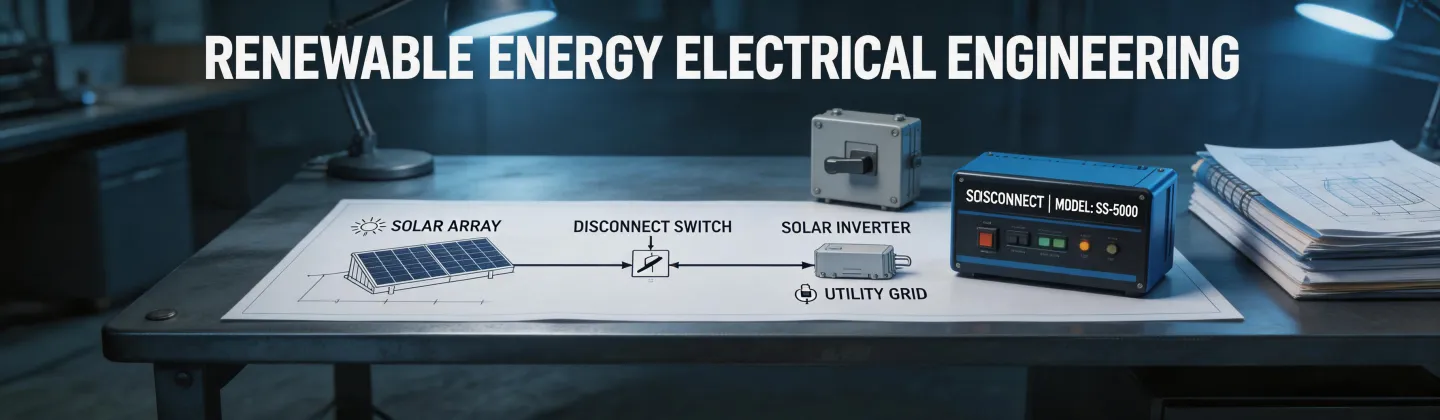
The project wasn't huge—a small community center with a 30kW solar array, a 50kWh battery, and an ABB PVS-30-TL-SY inverter at its heart. We were using ABB components throughout: the inverter, some switchgear, a transformer for the grid interconnection, and a couple of intelligent meters. The goal was islanding capability—being able to run off solar and battery when the grid went down.
This was my first microgrid design. I'd done straight grid-tie solar installs before, no problem. But a microgrid adds complexity: isolation points, anti-islanding controllers, and a whole lot of safety protocols. I didn't respect that complexity. I thought, 'It's just a solar system with a battery and a switch. How hard can it be?'
Mistake #1: Grabbing the Wrong Disconnect Switch Handle
The biggest headache came from a tiny component: the disconnect switch handle.
We had ordered an ABB disconnect switch for the battery bank. It was a 100A, 600V AC/DC switch—the big, industrial-grade kind. The switch arrived, but it didn't come with a handle. In my haste (and to save $40), I grabbed a universal handle from our scrap bin. It was a different brand, technically the same form factor, but it didn't have the correct interlock.
Let me tell you what happened when we tried to install it. The handle didn't have the right depth. When we mounted it, the handle would turn the switch to 'On,' but the locking mechanism didn't catch. I thought, 'It's just a plastic handle; it'll hold.'
It didn't. A week later, during a routine test, the handle vibrated itself off the switch shaft. The switch was jammed in the 'On' position. We had to emergency-shut down the entire battery system at the main breaker, which disconnects everything, not just the battery. The system was down for four hours.
The cost? $40 saved, $400 in emergency labor for the shutdown, plus $150 for the correct ABB handle (with rush shipping) and 4 hours of lost solar generation on a sunny day. That one decision cost us roughly $650 all-in. I should have just ordered the correct ABB disconnect switch handle from the start. It's a $20 part.
Lesson learned: Never, ever mix and match disconnect switch handles. The correct handle from the same manufacturer (ABB, in this case) has the right interlock and depth. It's not 'just a handle.' It's a safety interlock.
Mistake #2: The 'To Disconnect' Order on the Car Battery
Now, this one wasn't on the microgrid—it was on a smaller project. But it shows how basic knowledge gaps can cause real problems, even for experienced people.
I was helping a team swap out a 12V battery in an industrial UPS system for a critical server room. The battery was lead-acid, but the system was designed for high-reliability. I had a young technician on my team. He was bright, but he'd never worked on a UPS battery before.
I asked him: 'Which to disconnect first car battery terminal?' He said, 'Positive first, right? That's what I've seen on YouTube.'
I stopped him. 'No. Always disconnect the negative terminal first. Then the positive. On the way back in, install the positive first, then the negative.'
Why? Because disconnecting the negative first breaks the ground path. If your wrench accidentally touches the chassis while disconnecting the positive, you get a spark at best, a battery explosion at worst. Negative first, positive first on install.
I thought everyone knew this. But he didn't. The internet is full of bad advice. And, as I'd already learned with that disconnect handle, you can't assume 'common knowledge' is real knowledge. We now have this rule printed on every battery-related work order.
Mistake #3: The '5G Smart Meter' That Wasn't
Another microgrid project, another mistake. This time, it was about monitoring.
We needed a smart meter for the site's energy management system. The client wanted real-time data on solar production, battery state-of-charge, and grid import/export. I specified an ABB B-series smart meter with Modbus RTU. It worked fine with our ABB inverter. But the client's grid operator was requiring a specific 5G smart meter for the interconnection agreement. I didn't read the fine print.
We installed our meter and programmed the inverter. Everything passed commissioning. Then the grid operator rejected the application. They required a 5G-capable smart meter for remote disconnection and demand response. Our Modbus RTU meter wasn't compatible.
The fix? We had to replace the meter and install a communication gateway. The hardware cost $800 extra, plus two days of re-wiring and programming. Total waste: $1,200, plus a 3-week project delay.
The lesson? Always check the latest grid interconnection requirements. As of February 2025, many utilities in our region are requiring 5G smart meters for new solar and microgrid interconnections. Verify current requirements at your local utility's website before placing an order. You can't assume it's just 'a smart meter.'
The Real Cost: Why 'Time Certainty' Is Worth the Premium
Let me connect this to the bigger point.
I've now made, and documented, about 17 significant mistakes over my career, totaling roughly $14,000 in wasted budget. I'd say 12 of those were born from a single impulse: trying to save money by cutting corners or guessing instead of checking.
In March 2024, we had another urgent project. We needed a specific ABB transformer for a hospital microgrid. The timeline was insane: 3 weeks. Our usual supplier said 8 weeks standard. They could rush it for $400 extra. I didn't hesitate. I approved the rush.
Why? Because the cost of that project failing was $50,000 in penalties plus massive reputational damage. The $400 was a no-brainer. That's the time certainty premium. In emergency situations, the guaranteed deliverability is worth more than the lowest price.
My colleague Dave, who manages our warehouse, once tried to save $80 on a $2,500 order by choosing standard shipping to save a few days. The parts arrived late. The project was delayed. The delay cost us a night of overtime for the crew. Net savings: negative.
I now have a rule: any order with a hard deadline gets a 10% budget allocation for rush delivery. This might sound expensive, but since implementing this, we've missed exactly zero deadlines. We've also stopped having 'surprise' weekends on site.
My Reusable Checklist (The Hard-Won Version)
After the third rejection in Q1 2024 (for a different permitting issue), I created my pre-install checklist. Here's what it includes. It's not original, but it works.
- Component 1: Disconnect Switch Handle. Verify it's the exact SKU from the manufacturer. No substitutes. Measure the depth. Check the interlock.
- Step 2: Battery Connection Order. Written on the work order: Negative first (disconnect). Positive first (install).
- Element 3: Communications Equipment. Verify the exact model # with the utility's interconnection requirements from this month, not last year.
- Item 4: All Ancillary Components. Check the ABB official site for the latest software/firmware versions for the inverter/meter. This is a huge one.
We've caught 47 potential errors using this checklist in the past 18 months. Not all would have been costly, but at least 5 of them were $500+ mistakes waiting to happen.
Final Thought
I can only speak to my own context: we're a mid-size B2B integrator in the US with predictable ordering patterns. If you're a solo installer working on residential microgrids, your calculus might be different. You might have more flexibility. But the principle holds.
Don't save $40 on a handle and lose $650. Don't save $80 on shipping and lose $1,000. And for the love of all that is efficient, disconnect the negative terminal first.
Prices and utility requirements accurate as of February 2025. Verify current specs at your local utility's interconnection portal before starting work—things change fast in this industry.

Jane Smith
I’m Jane Smith, a senior content writer with over 15 years of experience in the packaging and printing industry. I specialize in writing about the latest trends, technologies, and best practices in packaging design, sustainability, and printing techniques. My goal is to help businesses understand complex printing processes and design solutions that enhance both product packaging and brand visibility.