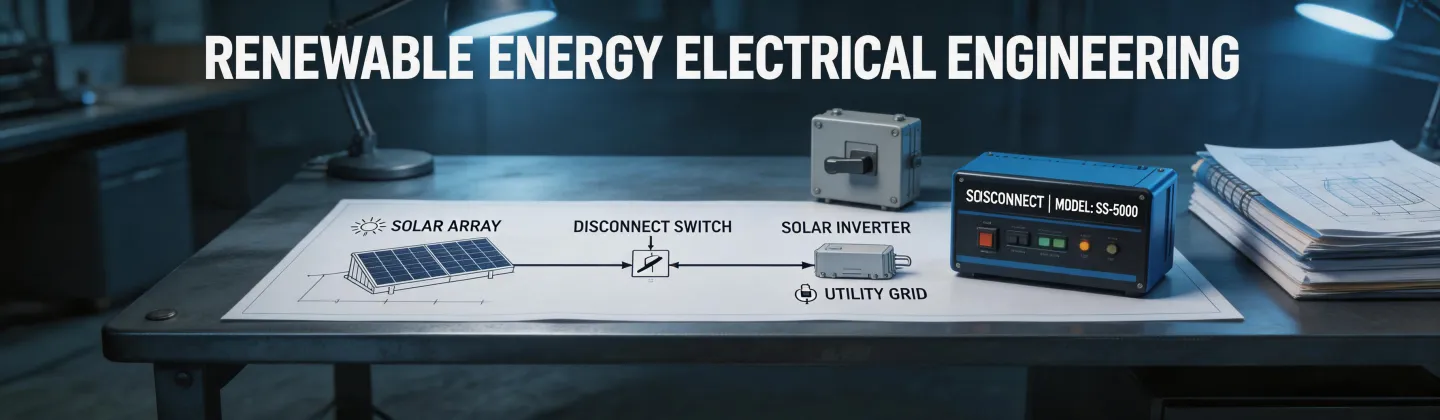
Ask three engineers which ABB disconnect switch you should buy, and you'll get three different answers. By the time the question reaches my desk, it's usually shortened to 'need ABB.' That's when I slow everyone down.
I handle procurement for a 40-person renewable energy electrical contractor. Since 2021, I've managed a component budget of a bit over $1.2 million a year, tracked every PO in my own cost system, and built a small collection of lessons from orders that looked right on paper and were wrong on site.
Here is the lesson in one sentence: ABB disconnects are not one product. They are a family of AC and DC switch-disconnectors, and the expensive mistake is ordering the wrong member of that family.
Classify the Job First
Before comparing part numbers, answer a more basic question: what are you actually disconnecting? In our work, the requests fall into four groups.
- Utility-scale solar, wind, or battery storage work, where the disconnect is already shown on the drawings.
- Commercial or fleet EV charging installations, where someone needs a lockable disconnect at the equipment.
- Small battery or off-grid systems, where the protection should match the battery voltage, not an industrial spec.
- Residential and DIY questions that should never be answered with an industrial disconnect.
The right product, the right paperwork, and the right budget are different in each group.
Scenario 1: Utility-Scale Solar or Wind — Buy to the Drawing
In a wind project, the owner's logistics team can spend weeks planning around transporting wind turbine blades. That is the visible schedule risk. The less visible risk is smaller: an ABB disconnect switch that arrives with the wrong auxiliary contacts, the wrong handle position, or no matching test documentation.
On utility-scale work, engineers rarely choose a disconnect switch by brand preference alone. They select it because the short-circuit rating, isolation characteristics, and certificate all match the system design. My job as a cost controller is not to make that decision cheaper. It's to make sure the exact specified item arrives on time, with the paperwork that lets the electrical inspector close the file.
If another vendor offers a similar product for a little less, the saving disappears the first time the engineer says, 'not what I specified.' Then you pay for the rework, the second delivery, and the schedule delay. That is the real total cost of ownership. Buy to the drawing, and let the brand do its job.
Scenario 2: Commercial EV Chargers — Buy the Lockout, Not Just the Switch
The second scenario is different because the person maintaining the equipment matters as much as the electrical rating. When we install chargers at a warehouse or fleet depot, the maintenance team needs to see a visible break and lock it off before touching the charger.
In the US, the NEC requires a disconnecting means for EV supply equipment under Article 625.43. In practice, that means a lockable switch in sight of the equipment. I don't buy a disconnect for that application without a padlockable handle and an enclosure rated for the location.
ABB switch-disconnectors are common in this spot for a reason. But I check more than the brand name. I check the number of poles, the AC or DC rating, the fault current rating, and the enclosure type. If the product documentation references IEC 60947-3 or UL 98, the file is easier to close. If it doesn't, then no marketing page is going to convince the engineer on site.
Scenario 3: Small Battery and Off-Grid — Don't Oversize the Disconnect
This is the scenario where I tell people to spend less money. Not every renewable energy project is a 40-foot container of switchgear.
We recently installed a remote monitoring hut with a 12-volt solar battery. Before choosing the battery, I spent an evening reading Renogy 12V 200Ah LiFePO4 battery reviews. The reviews were useful, but they also reminded me that the protection should match the system scale. A 12-volt battery box does not need a 1,500-volt DC industrial disconnect. It needs a correctly rated DC switch or breaker, placed close to the battery, with the battery management system doing its job.
I have mixed feelings about writing that in an article about ABB products. But if I ordered a massive switch-disconnector for a small battery cabinet, I would be spending the client's money on something that adds risk instead of removing it. The right disconnect is the one rated for the actual circuit, not the one that looks most impressive in a photo.
Scenario 4: The Search About a Ceiling Fan
If you landed here from how to install ceiling fan mounting bracket, stop before you add an ABB disconnect switch to a shopping cart. This is the residential branch, and it is a different conversation entirely.
A ceiling fan needs a fan-rated electrical box and a mounting bracket rated for the fan weight. It does not need industrial switchgear. If the existing ceiling box is not fan-rated, replace it. If you're not comfortable with the wiring, call an electrician. The procurement lessons above do not apply to a ceiling fan in a living room.
Which Scenario Are You In?
I'm not an electrical engineer, so I won't pretend to size a disconnect from here. What I can tell you from a procurement perspective is that the answer gets easier once you answer four questions.
- Does the project drawing already name a specific ABB product? If yes, order that exact product and all its accessories.
- Will a person need to lock the disconnect off for maintenance? If yes, a visible-break, lockable switch is worth the premium.
- Is the system 12, 24, or 48 volts? If yes, size the DC protection for that voltage and current, and don't buy industrial equipment just because the brand is familiar.
- Is this actually a household ceiling fan or a light fixture? If yes, close this article and start with the mounting bracket.
The honest answer is that I still choose ABB disconnects for most industrial applications because the documentation is complete and the engineering team trusts it. For a small battery cabinet, I choose the correctly rated switch and spend the savings on monitoring and protection. Both answers come from the same principle: buy the disconnect for the thing you are disconnecting, not for the logo alone.

Renata Silva
Renata Silva is a photovoltaic module analyst covering monocrystalline solar panels, bifacial modules, TOPCon and heterojunction designs, glass-glass construction, junction boxes, and module warranties. She interprets IEC 61215 and IEC 61730 evidence while comparing rated power, conversion efficiency, temperature coefficient, bifaciality, insulation, mechanical-load results, degradation assumptions, and tolerance. Her technical guides help EPC engineers, distributors, and project buyers separate qualification evidence from site-specific energy yield, climate exposure, installation constraints, and long-term performance risk.