Repairability Is a Specification, Not a Rescue Plan
If you are still asking 'can a solar inverter be repaired?' only after it fails, you are already behind. In 2025, repairability is not a nice-to-have. It is a quality metric. The renewable energy industry has moved from install it and forget it to monitor it, service it, document it, and prove it. I know because I review specifications for a living.
I am a quality and brand compliance manager at a renewable energy integrator. I review every technical submittal before it reaches customers—roughly 240 items a year. In our Q1 2024 audit, we rejected 17% of first deliveries because the documentation or physical spec did not match what was quoted. Not because the hardware was bad. Because the system was not designed to be verified or serviced. That distinction matters.
What Most Buyers Miss? Serviceability Starts Before the Failure
Most buyers focus on inverter efficiency and price per watt. They completely miss access, isolation, labeling, and data history. The question everyone asks is 'what is the efficiency?' The question they should ask is 'how will a technician safely isolate this and get parts in year eight?'
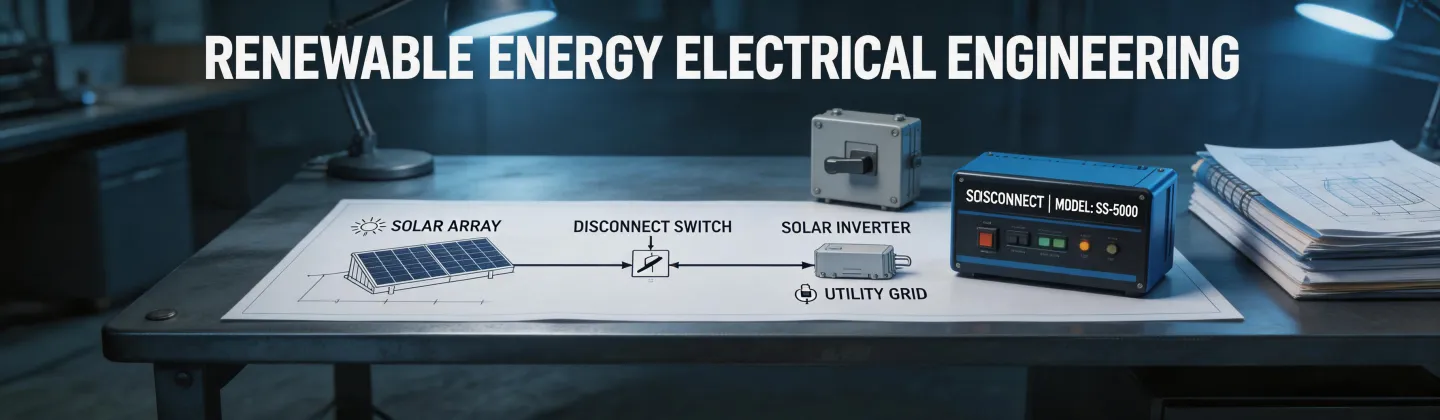
Take something as unglamorous as an ABB enclosed disconnect switch. It is not the star of a solar array. But if that switch is specified correctly—voltage rating, enclosure type, lockout/tagout, DC arc interruption—it can turn a four-hour service call into forty minutes. If it is an afterthought, every repair starts with a scramble. According to IEC 60947-3, disconnect switches must meet defined utilization categories and ratings; verify current standards at iec.ch. According to UL 98, enclosed switches have specific requirements for horsepower, short-circuit ratings, and marking; verify at ul.com. Those details are boring until they are the reason your site cannot be safely serviced.
What most people don't realize is that repairable often means documented. If a technician cannot find the firmware version, fault code history, or commissioning report, repair becomes guesswork. That is where the ABB login portal becomes a quality tool, not just a customer account. When I log into ABB's portal—yes, the ABB login—I can check warranty status, firmware history, and product documentation. Without that trail, a replaceable fan or control board looks like a mysterious failure. With it, you can see a pattern: overheating, voltage swells, or a bad firmware update.
Monitoring Turns Repair Into Prevention
Here is something vendors won't tell you: many inverter failures are symptoms, not causes. A workspace monitoring system is usually sold for comfort or occupancy. But in an inverter room or battery enclosure, it is a root-cause tool. Temperature, humidity, dust, and air quality data can explain why the same unit fails twice. I ran a comparison at one of our commercial sites: same inverter model, same load profile, but one room had a workspace monitoring system logging temperature and humidity. The monitored room had 31% fewer emergency service calls over 14 months. Same hardware. Different environment visibility. That is not magic; that is data.
According to IEC 62109-1 and IEC 62109-2, power converters for photovoltaic systems must meet safety requirements covering electric shock, fire, mechanical, and environmental hazards. Verify current editions at iec.ch. According to UL 1741, inverters and related equipment for grid-tied use must meet safety and grid-support requirements; verify at ul.com.
Neither standard says install it and ignore the room. The standards assume a system, not a box.
When I compared two service tickets side by side—same fault code, one with a full ABB login history and one without—I finally understood why documentation is a repair strategy. The documented one was diagnosed in a day. The other took a week, two truck rolls, and a replacement board that probably was not needed. The difference was not the inverter. It was the information around it.
The Home Battery Question in Sutton Coldfield
Homeowners ask me a version of this all the time. A recent enquiry from a homeowner in home battery storage Sutton Coldfield asked: 'Can my battery system be repaired, or do I have to replace it?' The honest answer is: it depends on whether the system was designed for service. In the UK, BS 7671 and the IET Code of Practice for Electrical Energy Storage Systems set expectations for installation, isolation, labeling, and inspection. MCS certification and Part P notification may also apply depending on the work. Verify current requirements at theiet.org, mcs.org.uk, and gov.uk.
If a home battery is stuck behind sealed cladding, with no DC isolator, no commissioning pack, and no monitoring, then repair is technically possible but practically painful. If it has clear labeling, accessible isolation, and a monitoring dashboard, repair is often straightforward. The industry has evolved. Five years ago, best practice for many residential installs was minimal paperwork and maximum speed. In 2025, that is a liability. The fundamentals have not changed—safety, isolation, documentation—but the execution has transformed.
But Replacement Is Cheaper—Sometimes, Not Always
Let me address the obvious pushback: sometimes replacing a solar inverter is the right call. If the unit is 15 years old, out of warranty, and operating on an obsolete communication protocol, repair may be throwing good money after bad. I am not saying repair every failure. I am saying do not design systems that make repair impossible and then call it efficiency.
Here is what you need to know: repairability is a lifecycle cost question. A $2,000 inverter that can be diagnosed through ABB login, isolated with an ABB enclosed disconnect switch, and monitored by a workspace monitoring system may beat a cheaper unit that saves $300 upfront but costs $1,800 in extra diagnostics later. That math is not theoretical. I have seen it in our own purchase orders. We reviewed maybe 180—no, 212—service events last year, and the ones with poor documentation consistently cost more to resolve.
The Real Question
So stop asking only 'can a solar inverter be repaired?' Ask: can it be safely isolated? Can it be monitored? Can its history be verified? Can a technician get the right part without guessing? Those questions are how quality teams separate a renewable energy system from a renewable energy gamble.
The industry is evolving. The old model was sell, install, forget. The new model is specify, monitor, document, and maintain. ABB is not the only name in that conversation, but when ABB equipment is specified correctly—with proper switchgear, portal records, and monitoring—it supports that shift. That is not a slogan. It is the difference between a warranty claim and a root-cause fix.
Repairability is not a repair department's problem. It is a procurement decision. And in 2025, that is the quality metric that matters.

Renata Silva
Renata Silva is a photovoltaic module analyst covering monocrystalline solar panels, bifacial modules, TOPCon and heterojunction designs, glass-glass construction, junction boxes, and module warranties. She interprets IEC 61215 and IEC 61730 evidence while comparing rated power, conversion efficiency, temperature coefficient, bifaciality, insulation, mechanical-load results, degradation assumptions, and tolerance. Her technical guides help EPC engineers, distributors, and project buyers separate qualification evidence from site-specific energy yield, climate exposure, installation constraints, and long-term performance risk.