-
What does ABB actually make?
-
Is an ABB disconnect handle worth the extra money?
-
Which ABB product catalog should I trust?
-
What should I look for in a van life solar kit?
-
Why do I specify a dual sensor smoke alarm with 10-year lithium battery?
-
What is the best portable solar generator?
-
Should I buy a portable solar generator or a van life solar kit?
-
Is ABB overkill for a small system?
Every few weeks, someone asks me for a product recommendation and then asks why I'm not excited about the cheapest option. I've managed procurement for a renewable energy installer for over six years, so I naturally think in price, lead time, and what happens when a part fails. I also work on enough off-grid and van builds to know where people get burned. Here are the questions I actually answer, plus the short version of my answers.
What does ABB actually make?
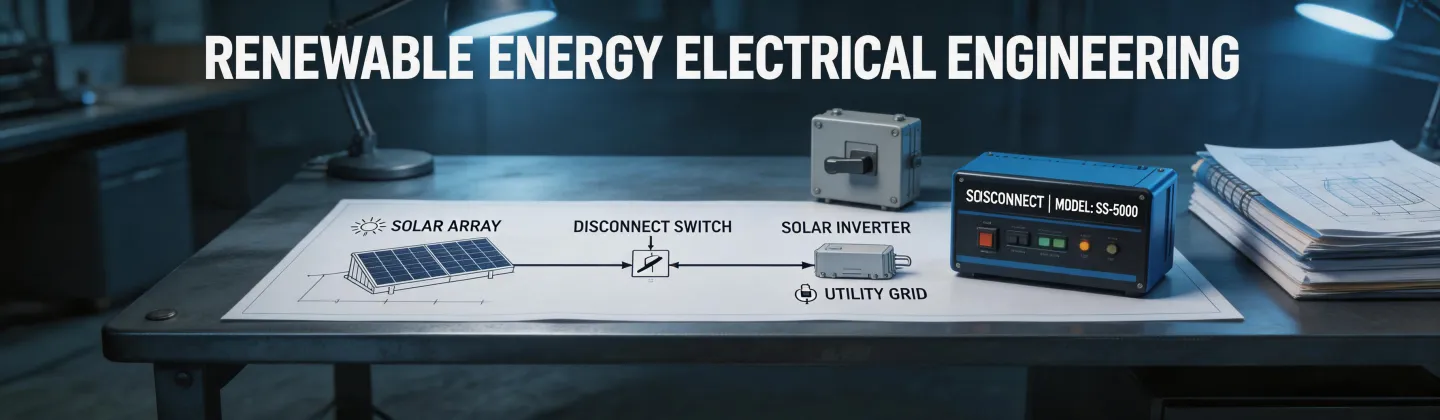
Most people know ABB from big industrial switchgear. But the ABB product catalog covers EV charging, solar inverters, wind inverters, UPS systems, transformers, switchgear, and energy storage. The old assumption was that ABB only belongs in utility-scale substations. That isn't really true anymore. I've used ABB's smaller contactors, breakers, and disconnect handles on commercial rooftop solar and even some high-end van builds. One thing that often surprises people: ABB doesn't make solar panels. They make the inverters and electrical components that connect panels to batteries, chargers, or the grid. Once you understand that, the catalog makes a lot more sense. The catalog is deep—which, honestly, is the problem. Finding the right part is easier once you know the category.
Is an ABB disconnect handle worth the extra money?
Short answer: yes, and I'll tell you why from a purely financial angle. In 2024, I compared quotes for a 48V off-grid setup. The generic handle was $28. The ABB disconnect handle was $71. My spreadsheet said save $43. My gut said the inspector might not accept the generic one. I went with my gut, and I'm glad I did. The enclosure was listed for use with the ABB handle only. If I'd bought the generic handle, the whole combination could have failed inspection. That's not a $43 risk; that's a $500 rework risk. There's also a safety piece. The handle provides a visible break and a place to put a padlock. When I'm working on a battery bank or an inverter, I want to know that no one can accidentally close the circuit. That peace of mind is worth more than the part cost.
Which ABB product catalog should I trust?
Use the official ABB product catalog, not a random PDF that ranks first in Google. I've seen outdated datasheets with discontinued part numbers. If you're pricing a job, go to abb.com and filter by category. I usually start with solar inverters, switchgear, and EV charging. The catalog also lists all the little things—disconnect handles, fuse holders, busbars, monitoring—that don't make it into the first budget but absolutely should. Missing a $30 accessory can delay an install by a week. And when you show up with the wrong SKU, the client remembers it. I've made that mistake once. I'd rather spend ten extra minutes in the catalog.
What should I look for in a van life solar kit?
I get why people like the idea of a complete van life solar kit: buy one box, install it, done. But too many kits hide the weak points. The panels may be good, and the charge controller may be budget. Check every component name. If the kit says 20A charge controller, ask whether that's the PV input rating or the battery output rating. I've seen kits where the controller could only handle 10A of solar, so the batteries never reached full charge in winter. Also check the breaker and fuse brands. If the kit doesn't name them, assume they're no-name. I've replaced more cheap DC breakers than I'd like to remember. You don't need a premium brand on every cable, but you do need a clear datasheet for every protective device.
Why do I specify a dual sensor smoke alarm with 10-year lithium battery?
This isn't the most exciting line in an off-grid budget, but I add one to every build. The dual sensor smoke alarm with 10-year lithium battery I typically spec combines ionization and photoelectric sensing. That covers both fast-flaming fires and slow smoldering ones. In a van with lithium batteries, inverters, and maybe a propane system, you have a lot of risk in a compact space. The 10-year sealed battery also removes the classic beeping-at-3am problem. According to NFPA (nfpa.org), smoke alarms should be replaced after 10 years, so the sealed battery matches the expected lifespan. This isn't an ABB product, but it belongs in any off-grid budget I'm involved with. The cost is small compared to the things it protects.
What is the best portable solar generator?
The practical answer is to start with a load calculation, not a brand. I've watched someone buy a 1200W unit because the box said 1200W. Then their fridge surged at 900W and the inverter shut down. They missed the fine print: 1200W peak, 700W continuous. The best portable solar generator for your situation is the one that handles your continuous load with some margin. For laptops and phones, a 300W to 500W pure sine wave unit is usually enough. For a fridge or power tools, you need 1000W or more of continuous power. Also check usable battery capacity and solar input. Those three numbers matter more than any best-of list. One more thing: if two units have the same wattage and one is significantly lighter, ask why. Sometimes that's good engineering. Sometimes it means a smaller battery.
Should I buy a portable solar generator or a van life solar kit?
Both can work. It depends on how you use the space. A portable solar generator is a complete power station in one case: battery, inverter, charge controller, and solar input. A van life solar kit usually means panels plus separate components. If you're full-time in a van, I'd rather build a fixed system: panels on the roof, a lithium battery under the seat, an inverter in a ventilated compartment, and proper disconnects. Keep a portable solar generator as a backup if you need one. For occasional weekend trips, a portable generator is simpler and easier to store. But don't buy a 500W portable unit thinking you'll upgrade to a fridge later. The upgrade cost will be higher than buying the right size first.
Is ABB overkill for a small system?
If you compare unit price, maybe. But I've learned to compare total cost over the life of the system. In 2023, I chose between a $14 DC breaker and a $42 ABB breaker. The $14 one fit the same DIN rail and looked identical in the photo. The datasheet, though, listed a much lower DC breaking capacity. I spent the extra $28. To me, a breaker isn't the place to save money. If a $28 part causes even one trip back to the site, it costs more than the part difference. That's the thing I wish more people understood: the lowest quote is not the same as the lowest total cost.

Renata Silva
Renata Silva is a photovoltaic module analyst covering monocrystalline solar panels, bifacial modules, TOPCon and heterojunction designs, glass-glass construction, junction boxes, and module warranties. She interprets IEC 61215 and IEC 61730 evidence while comparing rated power, conversion efficiency, temperature coefficient, bifaciality, insulation, mechanical-load results, degradation assumptions, and tolerance. Her technical guides help EPC engineers, distributors, and project buyers separate qualification evidence from site-specific energy yield, climate exposure, installation constraints, and long-term performance risk.