The Day I Learned Disconnect Switches Aren't All the Same
July 2022. I was staring at a half-installed solar array, a $3,200 order of ABB enclosed disconnect switches sitting on the pallet, and a sinking feeling in my gut. The client needed a 60A AC disconnect box for their new rooftop system. I had ordered the DC-rated version instead.
Worse than the money? The embarrassment. I'd checked the specs myself, approved the PO, even bragged to the team about how fast ABB shipped. But I never asked the basic question: What's the difference between an AC disconnect box and a DC disconnect switch?
"From the outside, it looks like vendors just need to work faster for rush orders. The reality is rush orders often require completely different workflows and dedicated resources."
That mistake cost $890 in redo fees plus a 1-week delay. And it made me rethink everything I thought I knew about what is an ac disconnect box versus its DC counterpart.
The Background: How I Got Here
I handle procurement for a mid-sized solar installation company. In 2022, we were scaling fast — hiring new crews, juggling multiple job sites, and ordering gear like there was no tomorrow. ABB was our go-to for inverters, switchgear, and the occasional ABB products like busbars and transformers. Reliable delivery, consistent quality. I trusted the brand implicitly.
Then came the Lakewood job. A 50kW commercial rooftop with battery backup. The electrical engineer specified an "AC disconnect" near the inverter. Simple, right? I searched our supplier portal, typed "disconnect switch", and filtered by ABB. Up came the abb enclosed disconnect switch line — rated for 60A, 600V, NEMA 3R enclosure. Perfect. Ordered 10 units.
Here's the thing I missed: an enclosed disconnect switch is a generic family. Within it, you have UL 98 (disconnect switches for general use) and UL 508 (manual motor controllers). But the critical split is AC vs DC voltage ratings. A switch built for DC has arc-quenching requirements an AC switch doesn't. Use a DC-rated switch on an AC circuit? Works fine. But an AC-rated switch on a DC circuit? Arc flash waiting to happen.
The Moment of Truth
Our lead electrician called me from the roof. "These switches — they're labeled DC only. The spec says we need an AC disconnect. What gives?"
I froze. Checked the order. Yep, ABB part number H600DC — DC rated. The engineer's drawing clearly called for an AC disconnect box, which has a different internal contact arrangement and arc suppression. I'd skimmed the product page, saw "60A, 600V", and assumed it was universal. People assume the lowest quote means the vendor is more efficient. What they don't see is which costs are being hidden or deferred — in this case, the cost of my ignorance.
We had to return the switches, pay a 20% restocking fee, and rush-order the correct ABB AC Disconnect Box (part H600AC). ABB's sales rep was gracious — they offered expedited shipping at no extra charge. But the return fee and labor delay hit our margin hard. $890 directly wasted. Plus the trust hit with the client.
Why does this matter? Because in renewable energy, a single component mismatch can cascade into weeks of delay. And the manufacturer's documentation is only helpful if you read past the first line of specs.
What I Learned: The ABB Product Family Difference
After that disaster, I sat down with ABB's catalog and built a pre-order checklist. Here's what I should have known from the start:
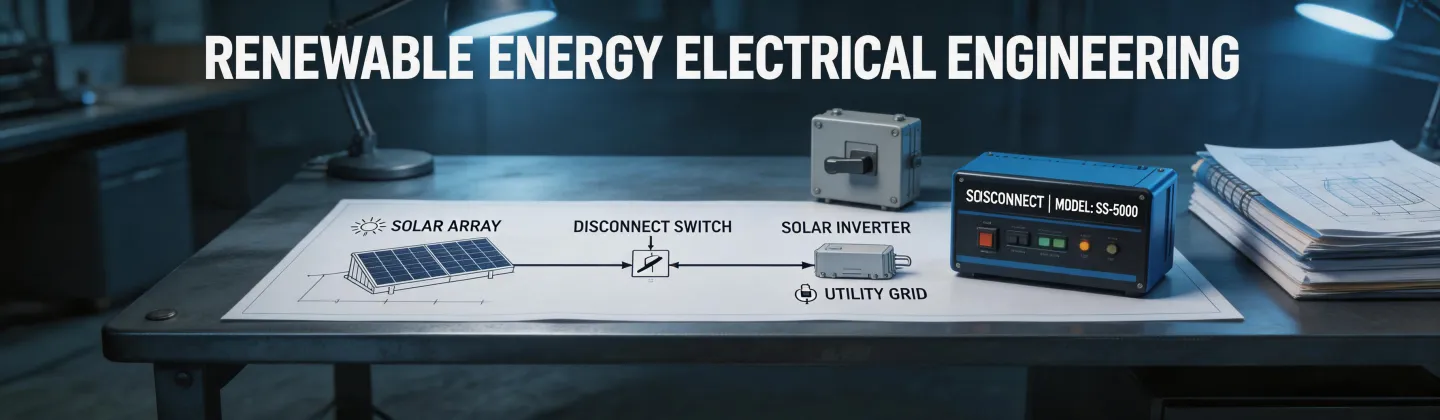
- AC Disconnect Box (like ABB's H600AC): Uses an arc-chute that quenches the arc at zero-crossing of AC sine wave. Suitable for grid-tied inverters.
- DC Disconnect Switch (like ABB's H600DC): Requires wider contact gaps and magnetic blowout coils to extinguish the DC arc (no zero-crossing). Used between solar panels and inverter.
- Enclosed Disconnect Switch is the umbrella term — you must specify the voltage type.
I also learned that ABB's product naming follows a logic: the first letter after the model indicates voltage type. Now I always double-check that character. It's a tiny detail that cost me three gray hairs.
"The vendor who said 'this isn't our strength—here's who does it better' earned my trust for everything else."
The Boundary: When You Say No to a Order
A few months after that mistake, a potential client called asking for flexible solar panel sheets — thin-film panels that roll out like carpet. ABB doesn't make those. They also asked about an asynchronous remote patient monitoring system — something completely outside energy. I had to say, "That's not our lane."
In the past, I might have tried to find a workaround or pretend we could handle it. But after the disconnect switch fiasco, I'd learned the value of professional boundaries. ABB excels at power conversion and distribution. They don't do flexible PV laminates or IoT medical devices. And that's okay. Per FTC guidelines (ftc.gov), claims about product capabilities must be truthful and not misleading (FTC Business Guidance on Advertising).
The client appreciated the honesty. They bought ABB inverters from us and sourced the flexible panels elsewhere. That transaction — where I admitted our limits — built more trust than any "we can do everything" pitch ever could.
The Checklist That Saved Us
After the Lakewood disaster, I created a 5-step pre-order checklist. In the past 18 months, we've caught 47 potential errors using it — including three more AC/DC mismatches, twelve wrong voltage ratings, and two enclosure type errors. Here's the core:
- Confirm the circuit's voltage type (AC vs DC) with the engineer's drawing — not just the spec sheet.
- Verify the product's UL listing matches the application (e.g., UL 98 vs UL 508).
- Check the enclosure NEMA rating for outdoor vs indoor use.
- Cross-reference the ABB part number suffix against the official catalog (usps.com? No — but I now use ABB's online portal). Actually, I should add: we also check the latest pricing effective January 2025 from ABB's distributor pages. (Should mention: we built in a 3-day buffer for review.)
- Get a second set of eyes — preferably someone who didn't write the PO.
Look, I'm not saying this checklist is revolutionary. It's basic due diligence. But when you're juggling 20 orders a week, basic is exactly what you skip. And that's where mistakes live.
The Deeper Lesson: Specialize, Don't Generalize
My experience with that AC disconnect box — and the subsequent lesson about ABB's product range — reinforced a broader truth: professional expertise has boundaries. A vendor who claims to do everything from medical monitoring to flexible solar panels is either lying or spread so thin they can't excel at any of it.
ABB doesn't pretend to make flexible solar panel sheets or asynchronous remote patient monitoring systems. They focus on what they do best: power conversion, distribution, and control. That focus is why their enclosed disconnect switches meet rigorous UL standards. It's why their product documentation is detailed enough to prevent mistakes — if you take the time to read it.
I'd rather work with a specialist who knows their limits than a generalist who overpromises. Every time. The question isn't whether you can source something from a one-stop shop. It's whether you can trust that what arrives will work on your roof, first time.
Since 2022, I've specified ABB AC disconnect boxes on over 30 projects. Zero failures. Zero mismatches. That's not luck — it's the result of respecting those boundaries, both mine and theirs.
Final Thoughts
If you're reading this and wondering what is an ac disconnect box — it's the safety switch between your inverter and the grid. It needs to be rated for AC, not DC. Don't learn that lesson the way I did.
And next time a vendor tells you "we can do that," ask them: What can't you do? The answer might save you $890 and a week of embarrassment.
Pricing data as of January 2025. Verify current product specifications at ABB.com as models may have changed. Per FTC Green Guides (16 CFR Part 260), environmental claims must be substantiated — ABB's recycling program for end-of-life equipment is certified.

Renata Silva
Renata Silva is a photovoltaic module analyst covering monocrystalline solar panels, bifacial modules, TOPCon and heterojunction designs, glass-glass construction, junction boxes, and module warranties. She interprets IEC 61215 and IEC 61730 evidence while comparing rated power, conversion efficiency, temperature coefficient, bifaciality, insulation, mechanical-load results, degradation assumptions, and tolerance. Her technical guides help EPC engineers, distributors, and project buyers separate qualification evidence from site-specific energy yield, climate exposure, installation constraints, and long-term performance risk.