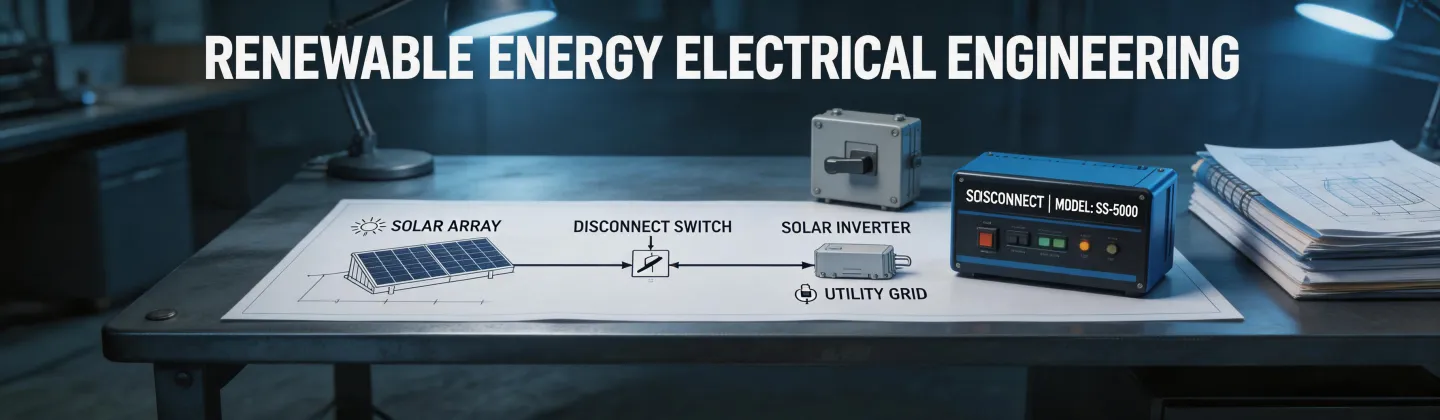
The email arrived on a Tuesday in March 2024. It was a quote for an AC disconnect box with breaker, and it was cheap. Not just cheap—43% cheaper than the ABB disconnects the engineer had specified. I almost sent the purchase order before asking my field electrician to look at it. He caught a problem that would have cost us weeks.
I need to back up.
I'm the procurement manager at a 180-person renewable energy installation company. I've managed our equipment budget—about $1.2 million a year—for seven years. I've negotiated with more than 40 vendors, tracked every order in our cost system, and built more TCO spreadsheets than I want to admit. I thought I had the 'buy on total cost' routine down. Then a community energy hub project showed me where my assumptions were wrong.
When I first started working with renewable energy equipment, I assumed the cheapest UL-listed part was the smartest buy. The spec sheets looked the same. The warranties sounded similar. The price difference was hard to ignore. Three years and two expensive re-inspections later, I learned that total cost of ownership matters more than the number on the purchase order.
The Project That Did It
We won a contract for a community energy hub about an hour from our office. The site needed a 300 kW rooftop solar array, two EV charging stalls in the parking lot, and one small wind turbine for demonstration. It was the first time our crews had to coordinate all three technologies on one site, and it made me realize how little I actually knew about the equipment I buy.
The Solar Inverter Question
The solar spec started straightforward. The engineer called out a 60 kW ABB solar inverter with multiple MPPT inputs. My first thought was: do we really need the name-brand unit? I'd watched cheaper inverters work well on smaller projects. But our senior engineer explained why MPPT mattered in this location.
MPPT stands for maximum power point tracking. In plain language, it lets different strings of panels run at their own optimum voltage even when one part of the roof is shaded. This project had trees on the west side and a mechanical penthouse that cast a late-afternoon shadow. With a single-tracking inverter, one shaded string could drag down the whole array. With the ABB solar inverter's multiple MPPT inputs, the system could keep harvesting from the sunny strings while the shaded strings underperformed. That's the difference between a good year and a mediocre year in solar production.
I understood it, but I still wanted to price out alternatives. Our engineer's answer stuck with me: 'You're comparing hardware. I'm comparing production over 25 years. The inverter is the brain of the array. Buy the one that thinks faster.'
It's tempting to think a solar inverter is just a box that changes DC to AC. It isn't.
A Disconnect Box Is Not a Light Switch
The equipment schedule also listed an AC disconnect box with breaker at each inverter and at the EV charging station. The drawings said ABB disconnects. I asked why, and got a lesson I now give to every new hire.
A disconnect gives a worker a physical, visible way to prove the circuit is dead. An AC disconnect box with breaker also interrupts current during a fault. The ABB version has a clear window and a lockable handle. That doesn't sound like a big deal until an electrician needs to see the contacts separated before tying into an energized system.
There's an old mindset that a disconnect is just a switch. That was always a little too simple. Today, with grid-interactive inverters and rapid chargers, the equipment can feed power from more than one direction. The 'it's just a switch' way of thinking is a legacy myth that can get someone hurt.
Then came the quote that almost ruined the project.
A vendor we had never used emailed a bid for an AC disconnect box with breaker at 43% less than the ABB part. The picture looked identical. The voltage and current ratings were the same. I sent it to our electrician and asked if we could substitute it. He called back in nine minutes.
'Look at the breaker,' he said. 'It's not UL classified for use in this enclosure.'
The enclosure was UL-listed. The breaker was UL-listed. But they hadn't been tested together as an assembly. Our local Authority Having Jurisdiction would reject that combination. We would have been forced to replace every box, redo the wiring, and wait two more weeks for inspection. The 'savings' would have become a $2,000 loss before we even counted the delay.
I signed the ABB disconnects and never looked back.
The Rapid EV Charger Had a Hidden Cost
The rapid EV charger was the part I worried about the most. We got three quotes for a 120 kW unit. The cheapest one was about $18,000 below the ABB Terra charger. At first glance, the decision looked obvious: same connector standard, same output, shorter lead time.
But when I ran the numbers on our utility rate schedule, the hardware price became almost irrelevant. A rapid EV charger can push a building's peak demand high enough to trigger thousands of dollars in monthly demand charges. If every vehicle charges at full power during the utility's peak window, the facility pays for that spike all year.
The ABB unit came with software that could stagger charging power and delay sessions during high-demand windows. I didn't understand the value until our CFO asked me to explain why the demand charge line on our last project was so high. That mistake taught me to model energy costs before buying charging equipment.
I'm still not sure how every utility calculates demand charges; some rate designs are more forgiving than others. But in this case, the software was the difference between a profitable project and a money pit.
The Simplest Question Was the Hardest
During the kickoff meeting, one of the future site operators asked me, 'How do wind turbines produce energy?' I started with 'They spin and make electricity.' Then she asked 'But how does spinning become electricity?' I didn't have a good answer.
I asked our senior engineer to explain it again, slowly, for the procurement guy with a spreadsheet instead of an engineering degree. Here's what I learned:
- The blades are shaped like airfoils. When wind blows across them, it creates lift, similar to an airplane wing.
- The lift force makes the rotor turn.
- The rotor spins a shaft connected to a generator, either through a gearbox or directly in a direct-drive turbine.
- The generator converts that mechanical rotation into three-phase electricity.
According to the U.S. Department of Energy's Wind Energy Technologies Office, that's the core mechanism: kinetic energy from moving air becomes mechanical energy, and then it becomes electrical energy. The output then passes through its own disconnects, breakers, and transformer before it can connect to the grid.
The customer didn't need to install a wind turbine to understand it. She just needed someone to treat her question seriously. That's the part I had to learn.
What I'd Do Differently
The community energy hub opened in November 2024. The wind turbine is a favorite talking point. The rapid EV charger has not needed a service call. The solar array is producing about 12% more than the initial model predicted. And I no longer make purchase decisions from a photo and a spec sheet.
A few lessons are now in our procurement checklist:
- Compare total cost, not invoice total. We now calculate commissioning, inspection risk, spare parts, production loss, and demand charges. That shifted the conversation away from 'who is cheapest' and toward 'what will this asset cost over time.'
- Ask the person who installs it. A field electrician can spot a bad enclosure, a poorly designed terminal block, or a missing label in seconds. I ask before I buy, not after.
- Teach the customer before they ask. An informed customer asks better questions and makes faster decisions. If you can explain how do wind turbines produce energy, why MPPT matters on an ABB solar inverter, or how a rapid EV charger affects demand charges, you don't need to hide behind marketing slides.
- Respect listed assemblies. The fact that a breaker is UL-listed does not mean it belongs in that enclosure. This one detail nearly caused a failed inspection.
I still look for ways to stretch a budget. I still negotiate. But now I ask one more question before I sign: 'What will this decision cost us after installation?' On this project, that question pointed me to ABB. On your next project, it might point somewhere else. But it's a question worth asking.

Renata Silva
Renata Silva is a photovoltaic module analyst covering monocrystalline solar panels, bifacial modules, TOPCon and heterojunction designs, glass-glass construction, junction boxes, and module warranties. She interprets IEC 61215 and IEC 61730 evidence while comparing rated power, conversion efficiency, temperature coefficient, bifaciality, insulation, mechanical-load results, degradation assumptions, and tolerance. Her technical guides help EPC engineers, distributors, and project buyers separate qualification evidence from site-specific energy yield, climate exposure, installation constraints, and long-term performance risk.