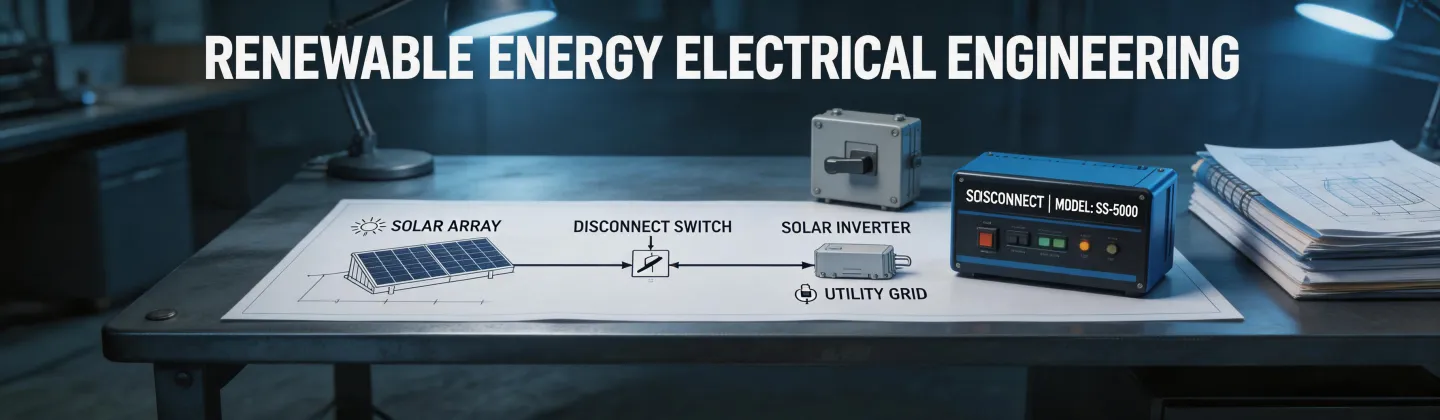
I've been handling off-grid solar installations for eight years. In three separate projects, I've personally made 14 significant mistakes—totaling roughly $7,000 in wasted budget. Now I maintain our team's installation checklist so nobody else repeats my errors.
This isn't a "how to design your perfect off-grid system" guide. It's the opposite. It's about the things that go wrong, the requirements that get overlooked, and the prices you actually pay when you skip the boring steps.
If you're shopping for off-grid solar system packages with batteries, this is the conversation I wish someone had had with me in 2021.
DC Disconnect Requirements: The Component That Melted
In September 2022, I installed a DC disconnect that looked right. The package included a "solar disconnect" — clearly labeled, neatly packed. I assumed it was compatible with my array.
What I mean is: I saw the word "solar" on the label, saw "600V," and moved on without checking the current rating. That was the first mistake.
Here's what I now know about solar DC disconnect requirements:
The disconnect must be rated for DC voltage and current. The contact gap inside a DC-rated switch is larger than an AC switch because DC arcs behave differently. In North America, AC sine waves drop to zero 60 times per second, giving arcs a natural moment to extinguish. DC never drops to zero. When you open a DC circuit under load, the arc persists until the contacts separate far enough. A switch that's not rated for DC simply doesn't have the physical gap to handle that.
According to the National Electrical Code (NEC) Article 690, photovoltaic systems must have a disconnecting means to isolate the array from the inverter. This is a safety requirement for firefighters and service personnel.
The amp rating matters just as much. The NEC requires disconnecting means to handle the array's short-circuit current (Isc) with a 125% safety margin. If your array has an Isc of 15 amps, the disconnect needs to handle at least 18.75 amps. Most people miss this because they look at the inverter's rating instead of the array's output, and think "that's plenty." The disconnect rating is about what the array can produce, not what the inverter expects.
I didn't do that math. During a routine service shutdown, the contacts fused. $890 in damage, a week of downtime, and a very uncomfortable phone call with the inspector.
That's when I realized we didn't have a formal verification process for incoming components. We'd check that the part existed and looked right, but we never checked its ratings against the system design. The third time we caught a mismatch using our new checklist, I finally understood that the process wasn't bureaucracy — it was money.
The replacement disconnect — from ABB Installation Products Inc. — cost $268 and has been flawless since. The spec sheet was downloadable from the ABB official site, which took about two minutes to find. If I'd spent two minutes checking the original part's ratings, I'd have saved $890 and a week of stress.
Hybrid Inverters: The "Simple" Component That Isn't
The question I get most often is "how does a hybrid inverter work?" It sounds like it should have a simple answer.
Here's the simplified version:
- Solar panels produce DC electricity. The inverter's MPPT trackers find the optimal operating point.
- DC is converted to AC for your loads.
- Excess DC charges the batteries.
- When solar isn't enough, the inverter pulls from batteries to keep the AC output steady.
- In off-grid mode, the inverter doesn't sync to the grid — it creates its own AC waveform. It IS the grid.
That's the theory. Here's the messy reality:
"Hybrid" covers multiple topologies. Some hybrid inverters use a high-voltage DC bus for batteries (380V–500V). Others use low-voltage battery connections (24V or 48V). These are not interchangeable. If you buy a hybrid inverter expecting 48V battery compatibility and your battery bank is 24V, the inverter will refuse to work—or worse, it reduces its output to near zero because it's misinterpreting the battery state.
The detail that burned me: the inverter's MPPT voltage range and its battery voltage range are different specifications. A hybrid inverter can have an MPPT range that accepts 90–500V from PV panels while the battery port only accepts 44–54V for a 48V battery bank. Mixing those up is easy because both numbers are printed on the same spec sheet.
Put another way: the MPPT range is about what the panels can feed in. The battery range is about what the batteries can absorb. They're separate systems that happen to share a common enclosure.
Most hybrid inverters also have a surge rating as well as a continuous rating. The surge rating matters for motor loads — well pumps, refrigerators, air conditioners. But surge ratings aren't infinite. They typically last a few seconds before protection kicks in.
In 2023, I sized a system for a cabin with a well pump. The continuous load was about 1,200W, and the inverter was rated at 3,000W continuous and 6,000W surge. I thought we had margin.
The pump's startup draw spiked to roughly 7,200W for about 800 milliseconds. The inverter shut down, waited five seconds, restarted, and shut down again when the pump cycled. This repeated for hours, and the batteries drained from the repeated restart attempts.
The surprise wasn't the pump's inrush—it was how little margin even a "properly sized" system had. If I'd measured the actual inrush with a clamp meter instead of guessing from the spec label, I'd have caught it. But I was in a hurry.
The fix: a soft-start device on the pump ($150) and a slightly larger inverter. The second inverter cost $1,200 more, but that was still cheaper than three more site visits at $450 each.
The Real Price: What Cheap Packages Actually Cost
Here's where I get on my soapbox about TCO — total cost of ownership.
My first off-grid package cost $4,200. It was the budget "everything included" option. After the disconnect failure and the inverter mismatch, I spent:
- Replacement DC disconnect: $268
- Second inverter: $1,200 more than the first
- Additional cabling and connectors: $180
- Inspection re-visits: $230
- Three site visits for troubleshooting: $1,350
- Downtime: 3 weeks of a cabin I couldn't use
The "bargain" package ended up costing about $9,600 before the system worked reliably. The properly spec'd system I eventually bought would have been $5,400 upfront — plus, each of my site visits was a day I could have spent on income-generating customers.
To be fair, the budget vendor wasn't trying to mislead me. Their package was designed for a typical installation, and my site had a well pump and specific requirements that pushed it outside "typical." The market normalizes for average, and off-grid installations are almost never average.
(Should mention: I also skipped the voltage drop calculation on the DC cabling between the array and the inverter. Undersized cable was contributing to the inverter's problems, and the inspector caught that during the re-inspection. It was another $200 in wire and connectors.)
My new rule: a cheap package isn't cheap unless it passes a design review. If the vendor can't review your specific loads and site conditions, budget $200–$500 to have an independent engineer look at it before you buy. I now calculate TCO before comparing vendor quotes.
In my case, $200 in design review would have caught: the wrong disconnect rating, the battery voltage mismatch, the pump inrush issue, and the undersized DC cable.
That's $7,000 for $200. I still kick myself for that trade.
My Four-Step Pre-Buy Checklist
Since the disasters, I run every off-grid solar package through this checklist before recommending it:
- Load analysis first. Measure your real loads—including motor inrush current, not just running wattage. This determines everything downstream.
- Verify solar DC disconnect requirements. Check the disconnect's DC voltage rating against the array's maximum system voltage (Vmax), and the amp rating against the array's short-circuit current (Isc). Confirm the disconnect is a listed DC switching device, not an AC switch in disguise.
- Read the hybrid inverter manual before ordering. Look at three numbers specifically: battery voltage range, MPPT input voltage range, and surge rating. If the vendor can't provide the manual upfront, that's a red flag.
- Get a design review. Whether from the vendor, a manufacturer's engineering support page, or an independent consultant. Use resources like the ABB official site or similar manufacturer documentation to compare specs. A few hundred dollars of review time saves thousands in rework.
That's it. Four steps. I'm not going to pretend this is a complete guide—it's what I wish I'd done before burning $7,000.
Since I put this checklist together, we've caught 47 potential errors before installation, including a transformer with mismatched phase connections and a battery bank wired for the wrong nominal voltage. The checklist works.
I still use the same vendors. I still buy budget packages—but only after running them through the review process. The phrase "well, it came with the package" now triggers an automatic red flag in my brain. If a component is in the package because it was cheap, not because it was right, it's not a deal—it's a liability.

Renata Silva
Renata Silva is a photovoltaic module analyst covering monocrystalline solar panels, bifacial modules, TOPCon and heterojunction designs, glass-glass construction, junction boxes, and module warranties. She interprets IEC 61215 and IEC 61730 evidence while comparing rated power, conversion efficiency, temperature coefficient, bifaciality, insulation, mechanical-load results, degradation assumptions, and tolerance. Her technical guides help EPC engineers, distributors, and project buyers separate qualification evidence from site-specific energy yield, climate exposure, installation constraints, and long-term performance risk.