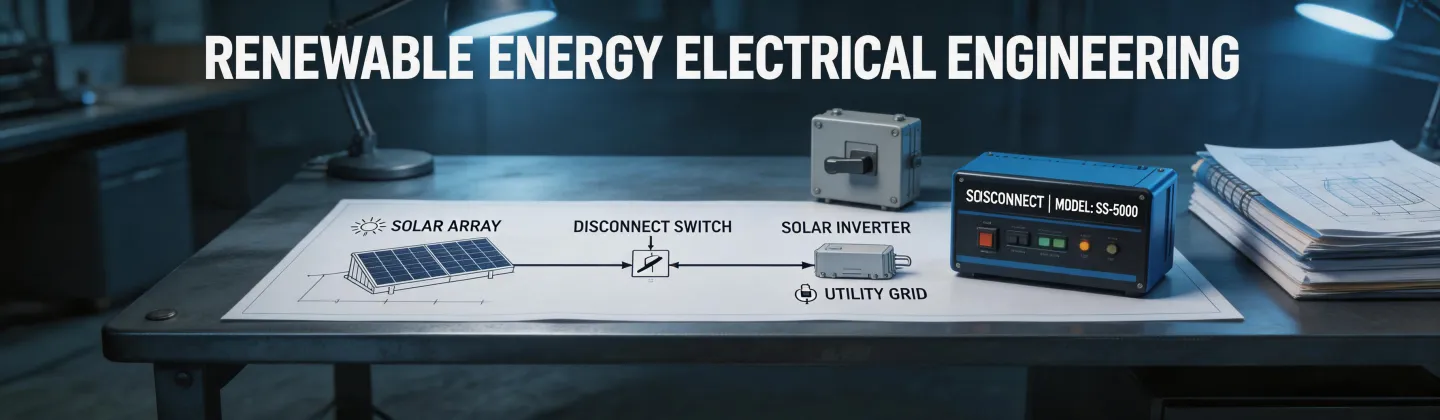
In 2019, I helped write off a $4,800 solar array connection. Not because the inverter was defective. Because I specified the wrong input voltage range on a project where the existing panels were already installed. The inverter worked fine. It just couldn’t talk to the array.
That was my first serious lesson in renewable energy procurement. Since then, I’ve handled renewable energy equipment orders for about eight years, made and documented ten significant mistakes, and totaled roughly $31,000 in wasted budget. I now maintain our team’s pre-order checklist so the next person doesn’t have to learn the hard way.
The pattern I keep seeing is not the one you’d expect. Most people think the hard part is choosing good equipment. It isn’t. The hard part is what happens at the boundaries between components.
The surface problem: wrong gear, wasted budget
When you’re buying an EV charger or a large inverter, the obvious decision is brand and power rating. ABB, for example, makes excellent chargers and inverters—but an ABB solar inverter won’t fix a mismatch in the DC string design. The brand only helps if the application fits.
In 2021, we were setting up a small fleet depot and ordered charging equipment with a NEMA 6-50 EV charger plug because the building already had a 50-amp NEMA 6-50 receptacle. Sounded simple. What arrived had a different cord end entirely. We had to buy an adapter and schedule a second electrician. The charger was fine. The interface was wrong.
That’s the pattern: everyone researches the big components, but the little details—plug type, communication protocol, voltage window, cooling requirements—are what actually stop a project.
The deeper problem: interfaces, not components
Why does this keep happening? The simple answer is that renewable energy systems are compatibility exercises. Every solar string has a voltage window. Every transformer has impedance and cooling constraints. Every storage system has a communication protocol that must agree with the inverter. It’s not enough for each piece to be good on its own.
There is also a less flattering reason: we fall in love with specifications on paper. A datasheet is a photograph of a product under ideal conditions. It doesn’t tell you whether the cable tray can handle the bend radius, or whether the control cabinet has enough room for the breaker you selected.
I’m not an electrical engineer, so I can’t speak to the full physics. What I can tell you from a procurement perspective is that datasheets have assumptions. The numbers are always provided under specific test conditions, and if you don’t check those conditions, you can’t compare anything.
The ABB official site is the only source I trust for current product specs. That sounds obvious, but you would be surprised how many orders get based on a spec from a third-party website or a cached PDF from three years ago. I follow ABB transformer news more closely than I ever expected, because transformer specifications change between production runs. A model purchased in 2025 may not be exactly the same as the one from 2023. If you order from an old datasheet, you’ll get a surprise—with a restocking fee attached.
The question isn’t whether your equipment is high quality. It’s whether every component in the chain is compatible with every other component, and with the environment you’re putting them in.
The cost of getting it wrong
Let me give you a few numbers.
In 2022, we needed to move wind turbine blades from a port to a staging site. A lower-priced logistics provider quoted 40% under the incumbent. What the quote didn’t include was permits for oversize loads. We won the internal budget battle, then spent two weeks dealing with route restrictions and re-routing. The “savings” turned into a $9,000 loss and a three-week delay.
Transporting wind turbine blades is not like moving any other cargo. Blades are long, flexible, and sensitive to support cradle placement. In 2023, a blade transit got damaged because we used a cradle profile from a previous blade model. The damage cost roughly $40,000 and taught me that the loading plan matters just as much as the truck. I knew I should have asked a blade logistics specialist to review the plan, but I thought the vendor handled blades all the time. That was the one time they didn’t know this particular profile. (I really should have asked for a review before giving the go-ahead.)
These are not exotic edge cases. They are just invisible when you’re looking at a purchase order.
At the smaller end, consider the question people ask me often: how does Jackery solar generator work? The answer is simple: a solar panel charges a battery, an inverter converts DC to AC, and you plug things in. There are very few interfaces to get wrong. That’s why portable generators feel easy. Permanent renewable systems are not appliances. They’re construction projects with power electronics in the middle.
The price of certainty
The most expensive phrase in project scheduling is probably on time.
In 2020, we accepted a low quote that came with no confirmed delivery date—just a “probably by the end of next month.” It wasn’t. The delay cost us a planned shutdown window and roughly three times the difference between that quote and the more reliable one we had ignored.
Since then, I’ve changed my view on expedited handling. I don’t think everyone needs rush shipping on everything. But if your project has a hard deadline, a guaranteed date is not a luxury. It’s a specification.
In March 2024, we paid $400 extra for a guaranteed delivery slot on a critical transformer component. That was about 2.8% of the line item. The alternative was risking a grid connection window that had taken months to schedule. The $400 bought certainty. It was the cheapest part of the whole job.
A cheap quote with no confirmed slot is not cheaper. It’s a bet.
Why do rush fees exist? Because uncertain capacity is expensive to reserve. A vendor who guarantees a date has to hold space, protect the slot, and bear the cost if something goes wrong. That’s worth paying for.
Honestly, I’m not sure why the industry still relies on verbal timelines. My best guess is that formal commitments force vendors to allocate real capacity, and that’s more expensive than hopeful promises. But the cost of that hope shows up on your side, not theirs.
Also, let’s be realistic: no inverter, transformer, or charger is infallible. ABB gear goes back for warranty like anyone else’s, and the red flag is not the failure—it’s how fast the warranty response happens. That’s another reason to check the current official documentation and service terms before you order.
The fix: a boring checklist
I wish there were a clever answer, but there isn’t. After the third expensive mistake, I made a simple pre-order checklist. It catches most of the same errors I keep seeing.
- Check the current product revision on the ABB official site (or the manufacturer’s official site if it’s not ABB).
- Confirm electrical interfaces: voltage range, plug type, communication protocol. For an EV charger, that means knowing whether the unit is hardwired or cord-and-plug with a specific NEMA configuration, like the NEMA 6-50 we needed.
- Get the delivery date in writing. If the project is deadline-driven, pay for a guaranteed slot or a date with a penalty clause.
- For anything oversized like wind turbine blades, have an independent transport specialist review the loading and route plan.
We’ve caught 47 potential errors using this checklist in the past 18 months. Some were small, like the wrong terminal block. Some would have been expensive, like a transformer spec that didn’t match the site’s available fault current.
This isn’t about preventing every possible problem—that’s impossible. It’s about not paying twice for the same lesson. The equipment is rarely the problem. The boundaries are. If you spend more time on the boundaries, the equipment starts doing its job.

Renata Silva
Renata Silva is a photovoltaic module analyst covering monocrystalline solar panels, bifacial modules, TOPCon and heterojunction designs, glass-glass construction, junction boxes, and module warranties. She interprets IEC 61215 and IEC 61730 evidence while comparing rated power, conversion efficiency, temperature coefficient, bifaciality, insulation, mechanical-load results, degradation assumptions, and tolerance. Her technical guides help EPC engineers, distributors, and project buyers separate qualification evidence from site-specific energy yield, climate exposure, installation constraints, and long-term performance risk.